
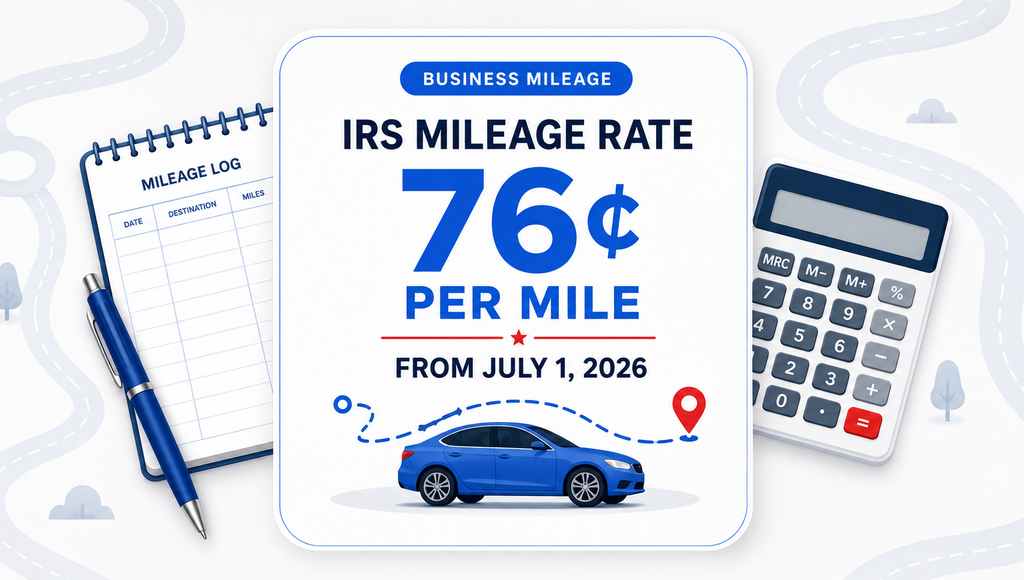
The IRS has made a midyear change to the 2026 optional standard mileage rates. According to IRS Announcement 2026-11, the revised rates apply beginning July 1, 2026, even though the announcement appeared in the Internal Revenue Bulletin dated July 13, 2026.
For self-employed drivers, business owners and organizations that reimburse employees for business use of personal vehicles, this creates a split-rate year. Mileage from January through June and mileage from July through December must be calculated using different rates.
| Quick answer: The IRS business standard mileage rate increased from 72.5 cents to 76 cents per mile for eligible business travel on or after July 1, 2026. The medical and qualified moving rate increased from 20.5 cents to 23.5 cents per mile, while the charitable rate remains 14 cents per mile. Business mileage before July 1 still uses the earlier 72.5-cent rate. |
What is the IRS mileage rate for the second half of 2026?
The business standard mileage rate is 76 cents per mile for eligible business mileage from July 1 through December 31, 2026.
| Mileage purpose | January 1 to June 30, 2026 | July 1 to December 31, 2026 | Change |
| Business | 72.5 cents per mile | 76 cents per mile | +3.5 cents |
| Medical | 20.5 cents per mile | 23.5 cents per mile | +3 cents |
| Qualified moving | 20.5 cents per mile | 23.5 cents per mile | +3 cents |
| Charitable service | 14 cents per mile | 14 cents per mile | No change |
The moving rate is available only for taxpayers who meet the applicable eligibility rules, including certain active-duty members of the Armed Forces and certain members of the intelligence community. The charitable rate did not change because it is fixed by law.
When does the new 76-cent mileage rate take effect?
The new rate takes effect on July 1, 2026. The date of the business travel determines which rate applies:
- Use 72.5 cents per mile for eligible business mileage from January 1 through June 30, 2026.
- Use 76 cents per mile for eligible business mileage from July 1 through December 31, 2026.
Do not apply one blended rate to all 2026 mileage. Keep the two periods separate in your mileage log and calculations.
The IRS announcement also contains a specific timing rule for mileage allowances. For the revised rate to apply, the allowance must be paid on or after July 1 and relate to transportation expenses paid or incurred by the employee on or after July 1. Organizations processing older reimbursement claims should review the precise wording in Announcement 2026-11.
Why did the IRS change the mileage rate in the middle of 2026?
The IRS said the modification resulted from recent increases in fuel prices. Midyear adjustments are unusual because the agency normally sets standard mileage rates annually.
The business rate is intended to reflect both fixed and variable vehicle-operating costs. The medical and moving rates are based on variable costs. The charitable rate is set by statute and therefore remains at 14 cents per mile.
The July announcement modifies Notice 2026-10, which originally set the 2026 business rate at 72.5 cents per mile and the medical and qualified moving rate at 20.5 cents per mile. All other provisions of that notice remain in effect.
How much difference will the higher rate make?
For every 1,000 eligible business miles driven from July 1 through December 31, the new rate produces $35 more than the original 72.5-cent rate.
For example, imagine a self-employed driver records:
- 8,000 eligible business miles from January through June
- 7,000 eligible business miles from July through December
The calculation would be:
- First half: 8,000 × $0.725 = $5,800
- Second half: 7,000 × $0.76 = $5,320
- Total calculated amount: $11,120
If all 15,000 miles were mistakenly calculated at 72.5 cents, the result would be $10,875. Correctly applying the second-half rate increases the calculated amount by $245.
This example illustrates the mileage calculation only. Whether a particular trip or amount is deductible or reimbursable depends on the taxpayer’s circumstances, applicable tax rules and the employer’s reimbursement policy.
Who can use the IRS standard mileage rate?
The standard mileage rate may be relevant to self-employed people, independent contractors, business owners and other taxpayers who are eligible to deduct vehicle expenses. Businesses may also use it when establishing or calculating mileage reimbursements.
The IRS mileage rate is optional. Eligible taxpayers may instead calculate the business portion of their actual vehicle expenses. You generally cannot claim both the standard mileage rate and the same actual operating expenses for the same vehicle and period.
Method-selection rules also apply. For example, an owner who wants to use the standard mileage method must generally choose it in the first year the vehicle is available for business use. A taxpayer using the standard mileage method for a leased vehicle generally must continue using it for the entire lease period. See IRS Publication 463 and consult a qualified tax professional about your situation.
Is 76 cents per mile a mandatory employee reimbursement rate?
No. The IRS standard mileage rate is an optional federal tax rate, not a universal requirement that every employer reimburse every employee at 76 cents per mile.
An employer may choose a different reimbursement arrangement. Employment agreements, company policy and state or local law can also affect what an employer must pay. Employers should review their policies and obtain professional advice where necessary.
What records should drivers keep?
A mileage deduction or reimbursement needs supporting records. A useful mileage log should capture:
- the date of each trip
- the distance driven
- the trip’s destination or route
- the business purpose
- the vehicle used
- whether the trip was business, personal, medical, moving or charitable
Drivers should classify trips promptly and preserve their records. Ordinary commuting between home and a regular workplace is generally not deductible business mileage, so it should not automatically be classified as business travel.
The IRS explains deductible vehicle expenses, recordkeeping and reimbursements in Publication 463. For individual tax decisions, consult a qualified tax professional.
What should businesses and drivers do now?
- Update mileage calculations from July 1. Apply 76 cents per mile to eligible business travel on or after that date.
- Keep the first and second halves of 2026 separate. Do not recalculate January through June business mileage at the new rate.
- Review reimbursements already processed. The announcement was published after its July 1 effective date, so check eligible July mileage that may have been calculated at the old rate.
- Update written reimbursement policies. Clearly state the effective date and the rate your organization will use.
- Maintain a detailed mileage log. A rate alone is not enough without records supporting the date, distance and business purpose of each trip.
MyCarTracks is ready for the new 2026 IRS mileage rates
MyCarTracks is ready for the midyear IRS rate change and the split-rate 2026 calendar. Eligible business mileage before July 1 can be calculated at 72.5 cents per mile, while eligible business mileage on or after July 1 can use the new 76-cent rate.
With MyCarTracks, drivers and businesses can:
- record trips automatically using a smartphone
- separate business and personal mileage
- keep trip dates, routes and distances organized
- prepare mileage logbooks and reports
- export records for review, reimbursement or tax preparation
- manage mileage records across multiple drivers and vehicles
Because the correct rate depends on the trip date, an accurate mileage log is especially important in a split-rate year. MyCarTracks helps reduce manual calculations and makes it easier to produce consistent records for both halves of 2026.
Install the MyCarTracks app and start tracking your mileage now
Frequently asked questions
What is the IRS business mileage rate for 2026?
There are two business rates for 2026. The rate is 72.5 cents per mile for eligible business travel from January 1 through June 30, and 76 cents per mile for eligible business travel from July 1 through December 31.
When did the 76-cent IRS mileage rate take effect?
The 76-cent business mileage rate took effect on July 1, 2026. The IRS published Announcement 2026-11 in the Internal Revenue Bulletin dated July 13, 2026, but made the revised rate effective from July 1.
Why did the IRS increase the mileage rate?
The IRS said it revised the optional rates because of recent increases in fuel prices.
Does the 76-cent rate apply to mileage driven before July 1, 2026?
No. Eligible business mileage before July 1 remains subject to the 72.5-cent rate. The 76-cent rate applies to eligible business travel on or after July 1, 2026.
What are the medical, moving and charitable mileage rates after July 1, 2026?
The medical and qualified moving rates are 23.5 cents per mile from July 1 through December 31, 2026. The charitable rate remains 14 cents per mile.
Does the new rate apply to electric and hybrid vehicles?
Yes. The IRS mileage-rate rules apply to eligible use of gasoline, diesel, hybrid and fully electric automobiles, subject to the other requirements and limitations of the standard mileage method.
Must employers reimburse employees at 76 cents per mile?
Not necessarily. The IRS rate is an optional federal tax standard, not a universal reimbursement mandate. An employer’s policy and applicable state or local law may impose different requirements.
What information should a mileage log contain?
A mileage log should record the trip date, distance, destination or route, business purpose, vehicle and mileage category. Records should be created promptly and retained with relevant supporting documents.
Is MyCarTracks ready for the July 2026 IRS mileage rate change?
Yes. MyCarTracks is ready for the split-rate year, allowing eligible business mileage before July 1 to use 72.5 cents per mile and eligible mileage on or after July 1 to use 76 cents per mile.
Sources
- IRS Announcement 2026-11, Internal Revenue Bulletin 2026-29, the authoritative announcement of the July 1 revisions
- IRS Notice 2026-10, the original 2026 standard mileage-rate guidance
- IRS Publication 463: Travel, Gift, and Car Expenses, guidance on mileage methods, vehicle expenses, reimbursements and records
- Journal of Accountancy: IRS raises standard mileage rates for remainder of 2026
- Thomson Reuters: IRS Announces Midyear Increase in Standard Mileage Rates
This article is for general informational purposes and does not constitute tax or legal advice. Eligibility and recordkeeping requirements depend on individual circumstances. Consult a qualified tax professional.