I used to think a paper mileage log was “safe” because it was simple. No sync issues. No exports failing. No GPS weirdness.
That’s true right up until the moment someone questions it.
The IRS substantiation request that turned my “pretty good” notebook into a problem
The letter showed up in late summer – an IRS notice asking for substantiation of vehicle expenses for a prior year. Not a sit-down-and-swear-in kind of audit. Just a clean request: send your mileage log and supporting records.
I did what a lot of people do. I photocopied my notebook and mailed it in.
It looked tidy: dates, miles, and a quick “client visit” note. The handwriting was even consistent because I’d rewritten some messy pages earlier in the year (I thought I was being responsible).
Two weeks later, I got a follow-up letter that didn’t feel “routine” anymore. It asked me to:
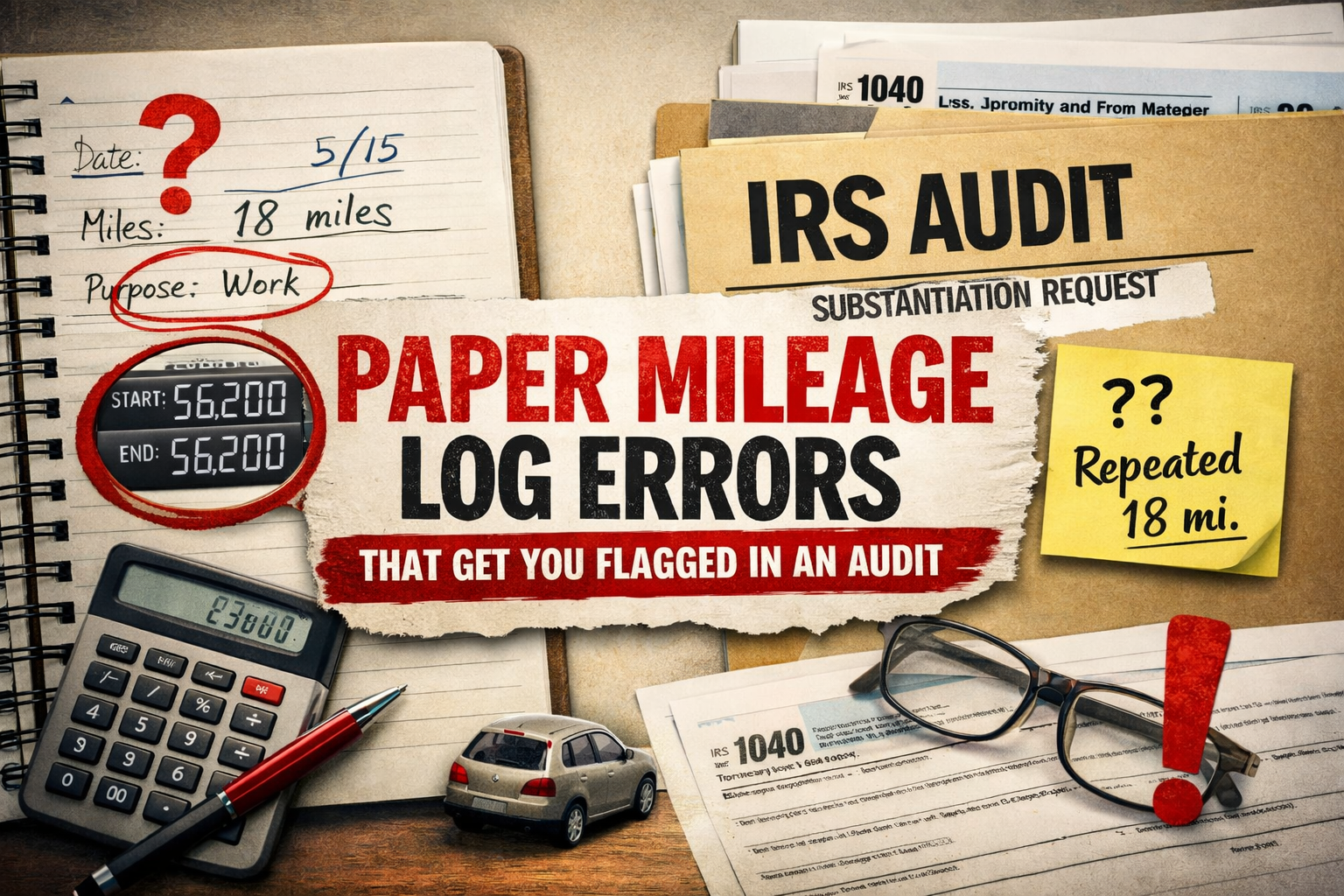
- clarify multiple entries where the odometer readings didn’t progress (same start and end numbers on different days)
- explain identical mileages repeated across different dates
- Provide a clearer business purpose for trips that only said “work.”
Then came the part that actually hurt: while the exam continued, my deduction was reduced. I could either argue it out slowly (and watch interest keep accruing) or pay the difference now.
I paid the difference to stop interest from snowballing. That’s the kind of payment you make with a tight jaw.
And the realization was immediate:
I didn’t have a mileage log. I had handwriting.
What examiners look for in a paper log (credibility, not columns)
A lot of online advice makes it sound like the IRS is checking whether you wrote down the right columns. Date, destination, purpose, miles – check the boxes, and you’re done.
In practice, the question is more like:
“Does this look like it was written as the driving happened, and does it fit with the rest of this person’s life?”
They’re not measuring your penmanship. They’re pressure-testing whether your record behaves like reality.
Paper logs lose credibility when they:
- don’t behave like real life (no gaps, no weird days, no “I forgot,” no detours)
- don’t behave like a vehicle (odometer that freezes, goes backward, or jumps oddly)
- don’t behave like a business (vague purposes, identical wording, no tie-in to appointments/invoices)
If your numbers don’t “hang together,” they don’t have to prove you lied. They can treat the mileage as unverifiable and reduce what you claimed.
Install the MyCarTracks app and start tracking your mileage now
The most common manual-tracking failure (and why it feels reasonable)
The paper-log failure isn’t usually “I never tracked mileage.” That’s obvious.
It’s the slow drift that happens to normal, busy people:
- You jot it down at the end of the day because stopping after every trip feels unrealistic
- You copied yesterday’s format because you’re tired and it’s faster
- You “fix” an entry later so the page looks clean (especially if you’re thinking ahead to taxes)
- You miss an odometer reading once, then you guess the next one, so the week looks consistent
That chain of tiny decisions is the real manual tracking failure: it turns a record into a reconstruction.
Common mistake: treating the notebook like a summary instead of a log.
A summary is what you meant to do.
A log is what actually happened – mess and all.
And here’s why the mistake feels so reasonable: you’re trying to be “helpful to future you.” You think neatness equals credibility.
Sometimes it’s the opposite.
Specific paper mileage log errors that trigger “unverifiable.”
These are the ones that get attention fast because they’re easy to spot and hard to explain when you’re staring at a letter and a deadline.
Odometer readings that don’t consistently increase
If your start/end odometer stays the same across multiple days, it reads like you filled it in later. If it goes backward even once, it becomes the entry they circle.
Pressure-test detail: examiners will literally scan for the odometer “story” to move forward. When it doesn’t, the whole page starts looking like a template.
Prevent it: pick a rule that reduces how often you write odometer numbers.
One defensible approach is:
- record start-of-day odometer once
- record end-of-day odometer once
- List trips in between with trip miles, not start/end odometer each time
Less copying means fewer chances for one digit to ruin a week.
Identical mileages on different days
When a log shows 18 miles, 18 miles, 18 miles on three separate days, it looks manufactured – even if you truly drive a consistent route.
Pressure-test detail: identical mileages don’t just look “unlikely.” They look like you copied the line and changed the date.
Prevent it: if the route is truly consistent, add the reason it’s consistent (“same warehouse run, same route”) and still capture deviations when they happen.
Business purpose that’s too vague to defend
“Work,” “errands,” “client,” “sales.” Those feel fine when you’re writing fast. They do not hold up when someone else is deciding deductibility.
Pressure-test detail: “work” is not a business purpose. It’s a mood.
Prevent it: add one specific noun that connects to real records.
- “Client: ACME site walk”.
- “Supply run: Home Depot (job 1842)”
- “Bank deposit + post office”
Not a paragraph. Just something that can be matched to a calendar event, invoice, or email later.
Clean corrections that erase the fact that you corrected anything
Crossing something out isn’t the problem. Rewriting an entire line so it looks like it was never wrong is.
I did this. I wanted the notebook to look “professional.” That urge is exactly what makes it feel reconstructed.
Prevent it: single strike-through, write the correction, and initial it. Old-school, yes. Also believable.
The year-end mismatch: your log doesn’t reconcile to the vehicle
If your total logged miles don’t even roughly align with what the car did that year, the log feels isolated.
Prevent it: write down the odometer on the first day you’re claiming mileage for the year and the last day. Even if you’re not tracking personal miles in the notebook, you want the business miles claimed to live inside a believable total.
One blunt truth:
If your paper log can’t survive five minutes of skeptical reading, it won’t survive a substantiation request.
The earned insight: a messier log can be more credible than a neat one
Beginner advice says “be neat” and “be consistent.” Sounds right.
Here’s the uncomfortable thing I learned: a perfectly consistent log is exactly what makes it look fake.
Real driving has:
- a day with no trips
- a weird detour
- a mistake you correct
- a note that’s shorter because you were rushed
When I stopped trying to make my notebook presentable and started trying to make it explainable, it got more credible. Messier, yes. More human.
The goal isn’t to win on precision.
It’s to win on plausibility.
A low-drama workflow to keep a paper log defensible
This isn’t fancy, but it holds up better than “I’ll catch up on Sunday night.”
Anchor the week with two numbers
- First driving day: start-of-day odometer
- Last driving day: end-of-day odometer
That creates a frame that your week has to fit inside.
Log trips as you stop (not at night)
You don’t need a perfect entry. You need a contemporaneous one.
Write:
- destination/area
- business purpose (one specific noun)
- miles (rounded is fine; invented is not)
Do a 6-minute Friday check
This is where paper logs either stay believable or slowly rot.
- Scan for repeating mileages that look copied
- Circle any “work” purposes and rewrite them while you still remember
- Check that your trips don’t exceed your start/end odometer frame
Keep a thin “why file”
Not a shoebox of guilt. A small folder with a few things that connect the log to reality:
- a calendar view
- a couple of invoices
- a few emails/texts showing appointments
You’re not proving every mile. You’re proving you had a real business rhythm that matches your log.
After my notice, I kept paper for a while, but I got tired of my own handwriting becoming evidence. In my case, I use MyCarTracks as the record I reconcile against – mainly because it gives me something consistent to point to when my memory gets creative.
The point isn’t paper vs app.
It’s whether your process produces a record you can defend months later, under pressure, with someone else holding the questions.