
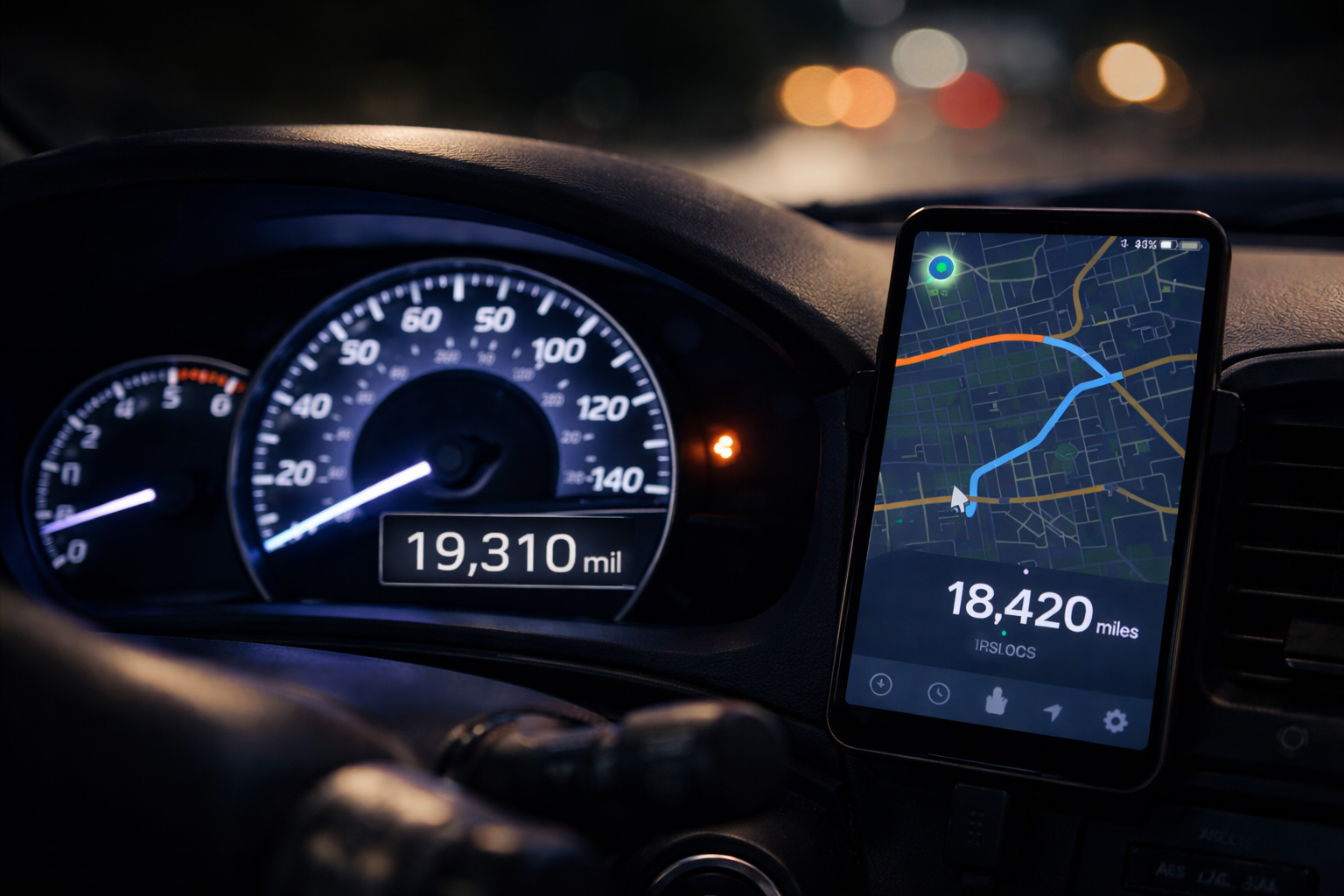
Mileage mismatches are normal. The problem is what they look like when someone else is judging your records.
If your GPS log says 18,420 business miles and your odometer-based total says 19,310, the gap isn’t the scary part.
The scary part is not being able to explain it without sounding like you made it up.
The IRS letter that made the mismatch matter (and what I realized too late)
I got the IRS notice in late August – a request to substantiate vehicle expenses for a prior-year Schedule C. Not an “audit TV show” moment. Just a plain letter with a deadline and a checklist.
I printed my mileage report from my tracking app, feeling pretty good. Then I pulled my oil change receipt because it listed the odometer.
The numbers didn’t line up.
My GPS report was lower by just under 900 miles than what my odometer-based math suggested for the year. I emailed my preparer the report anyway and basically said, “GPS is accurate.”
Two days later, he called and said, carefully, “They’re going to ask why your total miles driven don’t reconcile. And ‘because GPS’ isn’t an explanation.”
Consequence: I spent my weekend rebuilding a reconciliation narrative instead of working, and I agreed to reduce the deduction amount to avoid a longer back-and-forth. Real money.
Realization: this is where I messed up – I assumed the “official-looking” report was self-explanatory.
Why GPS miles and odometer miles don’t match (and why that’s not automatically a problem)
A GPS tracker and an odometer measure distance differently.
- Odometer: counts wheel rotations converted to distance based on tire size/calibration. It’s consistent inside your car. It can be biased a little high or low depending on tires, wear, calibration, and sometimes it’s intentionally conservative.
- GPS: estimates distance from a series of location points. If the app records fewer points (battery settings, background restrictions, poor signal, “optimized” tracking), it can “cut corners” on your route. It can also drop portions of a trip and still look like a complete day.
So yes, both can be “right” in their own way and still disagree.
The IRS isn’t requiring GPS to match your odometer reading mile-for-mile. What they care about is whether your method is consistent, contemporaneous, and explainable.
That last word is the killer.
The mistake that turns a normal mismatch into “unreliable records.”
The common mistake is trying to force one number to be The Truth.
People do one of these:
1) They submit GPS miles and treat the odometer as irrelevant.
2) They “fix” the GPS miles by sprinkling extra miles across trips until the totals match the odometer.
Both look bad under scrutiny.
Here’s why: the moment you start making the totals magically agree, you’ve changed the conversation from “measurement difference” to “did you alter records.” Even if your intent is honest, it reads like reconstruction.
And once credibility is in question, everything else gets harder.
Install the MyCarTracks app and start tracking your mileage now
A defensible way to reconcile the gap (without pretending one number is perfect)
What held up for me (and what my preparer was willing to stand behind) was a simple reconciliation approach:
1) Separate the three totals instead of arguing about one
Write down:
- Odometer total miles driven for the year (start-of-year odometer to end-of-year odometer)
- GPS logged business miles (what your report shows)
- Non-business miles explanation bucket (commute/personal/errands + untracked gaps)
You’re not trying to prove GPS equals odometer. You’re showing that the odometer represents all driving, while the GPS report represents business trips captured under your method.
2) Identify the “gap drivers” that are specific and boring
Audits don’t get resolved by clever arguments. They get resolved by boring consistency.
Pick the few reasons that honestly apply and stick to them:
- Background tracking interruptions: iOS/Android battery optimization can pause tracking, especially after updates.
- Signal loss segments: parking garages, dense downtown cores, rural dead zones.
- Trip segmentation: short repositioning moves (across a lot, between nearby stops) that your odometer counts but GPS may smooth out.
- Route geometry: GPS “connect-the-dots” vs the actual curves, ramps, and detours the odometer captures.
You do not need ten reasons. You need two or three that match your real driving.
3) Anchor the explanation with a small sample, not the whole year
This is the part people skip.
Pick one week (or even 3–5 representative days) where you have:
- a GPS trip list
- a photo/receipt/service record showing odometer near that time (oil change, tire rotation, inspection, even a dated dash photo if you took one)
Then demonstrate, plainly:
- GPS total for those days
- odometer difference across those days
- the observed variance (example: “GPS captured ~96–98% of odometer distance that week”)
That’s your credibility bridge: you’re showing the mismatch is a pattern, not a conveniently one-time issue.
4) Choose the number you claim, and explain why you chose it
For the standard mileage deduction, you’re claiming business miles.
If your GPS is lower than odometer-derived estimates, you can claim the GPS-based business miles and explain the mismatch as measurement + capture limits.
If you try to claim odometer-based business miles, you’ll need a reliable way to separate business vs personal. Most people can’t do that cleanly from the odometer alone.
This is where a lot of deductions die: not because miles weren’t driven, but because the separation method isn’t defensible.
The earned insight: the more you chase “exact,” the less believable you sound
Beginner advice says: “Make it match. Auditors like clean numbers.”
In real life, forcing agreement between GPS and odometer is exactly what makes you look guilty.
The uncomfortable truth I learned: a small, acknowledged mismatch with a consistent method is easier to defend than a perfectly reconciled spreadsheet you ‘adjusted.’
When I stopped trying to win the math argument and started documenting the method, the conversation changed.
What to write down so the explanation survives six months from now
If you’re going to explain a mileage mismatch, future-you needs a short note you can hand to your preparer (or an examiner) without reinventing the story.
Capture this in a single document:
- The tracking method used (GPS app name, phone used)
- Any known tracking interruptions (phone OS update month, battery optimization setting, new phone)
- Start/end odometer readings and how they were obtained (photo, service record)
- A short reconciliation statement (3–5 sentences)
- Your sample week support (GPS report + odometer anchor)
After getting burned once, I switched my workflow to keep both a GPS trip record and periodic odometer anchors in the same place. In my case, that ended up being MyCarTracks for the trip record, plus a quick odometer photo at the start of each month.
Not because it makes the numbers “perfect.”
Because when the letter shows up, I can explain the gap like an adult and move on.